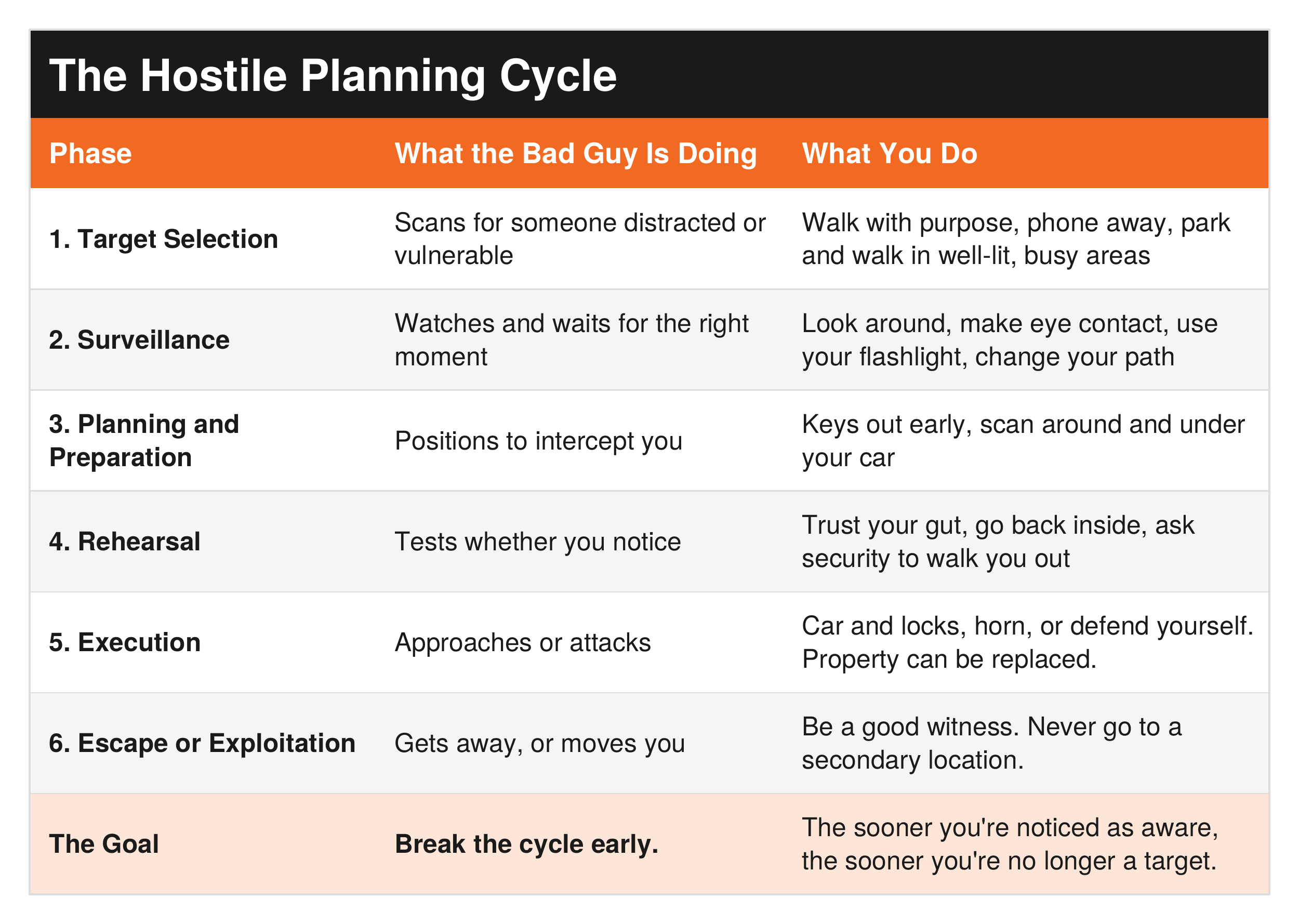
The Hostile Planning Cycle
How the Bad Guy Picks the Person, the Time, and the Place, and How to Break the Cycle
By Larry Betz | Prepared Not Paranoid https://www.preparednotparanoid.com/
Picture this. It's the holidays. You're walking out of the mall after dark, arms full of bags, a child holding your hand, your phone buzzing in your pocket. You're thinking about dinner, the next stop, the list.
You're distracted. You're preoccupied. And to the wrong person, you look like the easiest target in the parking lot.
Whether it's holiday shopping, a busy travel day, or just a late run to the grocery store, this is when we're most vulnerable. Stay vigilant.
The Bad Guy Has a Process, Too
As the Agent in Charge of your family's safety, you should have a process and a plan for scanning your environment and picking up on anything out of place. The bad guy has a process too, and his is built to find easy targets.
When I give my Situational Awareness talks, I cover Cooper's Color Code, the OODA Loop (Observe, Orient, Decide, Act), and how to add awareness and planning to your daily life without being paranoid.
The bad guy uses something called the Hostile Planning Cycle (also called the attack cycle) to pick the person, time, and place. The model was first developed to describe how terrorists plan attacks, but the same steps show up in everyday crimes like robberies and carjackings.
Understanding this cycle helps you spot, disrupt, and prevent a threat, especially in vulnerable moments like walking through a dark parking lot. It's always better to have a heightened level of awareness and avoid a situation than to be caught off guard.
Before We Go On: Carry a Good Flashlight
ALWAYS HAVE A GOOD FLASHLIGHT READILY AVAILABLE! I can't emphasize this enough.
You can take a flashlight with you almost everywhere, including through a TSA checkpoint (with some restrictions, like spare lithium batteries). The light on your phone is not a good flashlight.
A real flashlight helps you:
Light up any area you're unsure of
Spot a tripping hazard
Check around and under your car
Distract and identify a possible bad guy. Shining 1,500 lumens into someone's face buys you time and lets you see who's there.
Remember, a bad guy doesn't want three things:
To get caught
To get hurt
To take too long
Lighting up your area and your path sends a signal: pick another target.
Phase 1: Target Selection
This is where a criminal scans the environment for someone who seems distracted or vulnerable.
To reduce your vulnerability:
Walk with confidence and purpose.
Put your phone away.
Park and walk in well-lit, busy areas.
In a parking garage, have your flashlight and keys out before you leave the building.
As you get close to your car, scan your environment, check in with your instincts, and see if anything stands out.
If you have luggage, packages, or children with you, YOU WILL BE DISTRACTED. This is when you're most vulnerable, and a bad guy knows it.
Side note: Be extremely cautious in mall parking garages and parking lots with anyone offering to sell you something or have you sample something. It can be a tactic to distract you.
Phase 2: Surveillance
Once a target is picked, criminals usually move to surveillance. They watch what you're doing and wait for an opportune moment, like when you're loading luggage or packages into your vehicle.
Staying alert, making eye contact with people nearby, and using your flashlight all signal that you're aware, and that can deter someone who's watching.
If you notice someone lingering or watching you:
Change your path.
Move toward a more populated area.
Use your flashlight to show you see them.
Ask in a firm voice: "Can I help you?"
If you change your path and he changes his to mirror yours, that's a red flag. You may be his target.
At that point, you'll need to make a decision, and my advice is to make the safest decision possible. There are too many scenarios to give you one plan, but in general: keep moving and keep thinking.
Phase 3: Planning and Preparation
Now the bad guy prepares his approach, possibly by positioning himself to intercept you.
By this point, your keys should already be out so you're not fumbling at the car. A quick scan around and under your vehicle with your flashlight adds another layer of security.
Phase 4: Rehearsal
In rehearsal, someone may do repetitive or unusual things to test your awareness and see if you notice.
If someone is acting strangely, trust your instincts and keep thinking. Consider going back inside or letting security know. Most security professionals are more than happy to walk you to your car. Ask.
Phase 5: Execution
This is when the attacker makes his approach or attack.
If you sense an immediate threat, ask yourself: what is the safest option right now?
Get in your car and lock the doors?
Hit the horn or panic button to draw attention?
In the worst case, defend yourself?
Here's the hard truth. Based on the well-known Tueller Drill, an attacker can close a 21-foot distance in about 1.5 seconds. That is not enough time to get your belongings in the car and lock the doors.
Remember: property can be replaced. You can't.
Phase 6: Escape or Exploitation
In the final phase, the attacker plans his exit to avoid capture, or tries to keep exploiting the situation.
If he's escaping, do your best to be a good witness and report every detail you can to the authorities: height, build, clothing, direction of travel, vehicle, and plate.
If it's moved to exploitation, you have a big problem. A bad guy wants one of three things: your body, your property, or your life. There are too many variables to give you a plan here, but chances are you'll need to defend yourself.
At all costs, avoid being taken to a secondary crime scene.
Violence Loves Speed and Surprise
All of this can happen in a few seconds. Violence loves speed and surprise.
Recognizing and disrupting the Hostile Planning Cycle in real time gives you the time and space to make you and your family a hard target.
Ask Yourself
When I walk to my car, am I looking around, or looking at my phone?
Do I have a real flashlight with me right now?
If someone mirrored my path in a parking lot, what would I do?
What to Say
Short, firm, and loud enough to be heard:
"Can I help you?"
"Stop right there."
"Back off!"
Remember
The bad guy is looking for someone who won't notice him. Notice him first. Awareness gives you time, and time gives you options.
Go Deeper
Everything in this post comes back to awareness: reading your environment, spotting what's out of place, and making calm decisions before you're under pressure. My book Situational Awareness and Safe Family Travel Strategies gives you the full strategy, from Cooper's Color Code and the OODA Loop to parking lots, hotels, airports, and keeping your family safe on the road. Your family's safety is worth the investment. [Get the book here: LINK]
The Family Safety Toolkit includes 20 ready-to-use checklists, including Witness Skills, so you know exactly what details to remember and report if something does happen. [Get the Toolkit here: LINK]
Free download: Get my free Travel Safety checklist bundle, including the Rental Car Checklist. [CTA: Comment or DM "[KEYWORD]" / or download it here: LINK]
Tools I recommend: You'll find the flashlights and personal safety gear I recommend in my Amazon store. [AMAZON STORE LINK]
Related reading:
Red Cell Your Family, Part 1: Think Like the Threat [LINK]
Situational Awareness and Movement series, Part 1: What the Research Shows [LINK]
How to Avoid Getting Stuck in a Protest While Driving [LINK]
Parent Pro Tips: Staying Together in Crowded Places [LINK]
References
Lexipol, A Police Officer's Guide to the Terrorist Attack Cycle: https://archive.lexipol.com/resources/blog/a-police-officers-guide-to-the-terrorist-attack-cycle/
Tueller, D. (1983). How Close Is Too Close? SWAT Magazine (the "21-foot rule").
Cooper, J. Principles of Personal Defense (Cooper's Color Code).
Boyd, J. The OODA Loop (Observe, Orient, Decide, Act).
Transportation Security Administration, What Can I Bring? (check current rules for flashlights and batteries before you fly): https://www.tsa.gov/travel/security-screening/whatcanibring/all
Disclaimer
These suggestions are intended to help you and your family build awareness, confidence, and safer decision-making habits. No safety plan, checklist, or training can guarantee 100% protection. This article is not legal advice and is not a substitute for professional self-defense or firearms training. Self-defense laws vary by state. The goal is not to create fear, but to help guide families toward more informed, prepared, and practical safety decisions in everyday life.
If you are in immediate danger, call 911.
Awareness gives you time. Time gives you options.
The prepared protector is someone who's decided that loving someone means being ready for them, not just hoping things go fine.
Prepared Not Paranoid. Protecting the Most Vulnerable Among Us.